
Most product testing happens under the best conditions the product will ever see. New, dry, clean, indoors, roughly 70 degrees. Then the thing gets sold, and it spends the rest of its life somewhere else.
There’s a detail buried in a Rand SIM case study about an Olympic helmet project that makes this concrete. The engineering consultancy D2H Advanced Technologies was brought in by a company that had already solved the aerodynamics of a new competition helmet but needed the shell to actually pass structural certification. The part worth paying attention to isn’t the speed of the work. It’s what they chose to simulate.
They ran the helmet from -20 degrees Celsius up to 38 degrees, and separately under artificial aging and water absorption conditions. Not the helmet as it leaves the factory. The helmet as it exists on a cold morning in its third season, having been rained on.
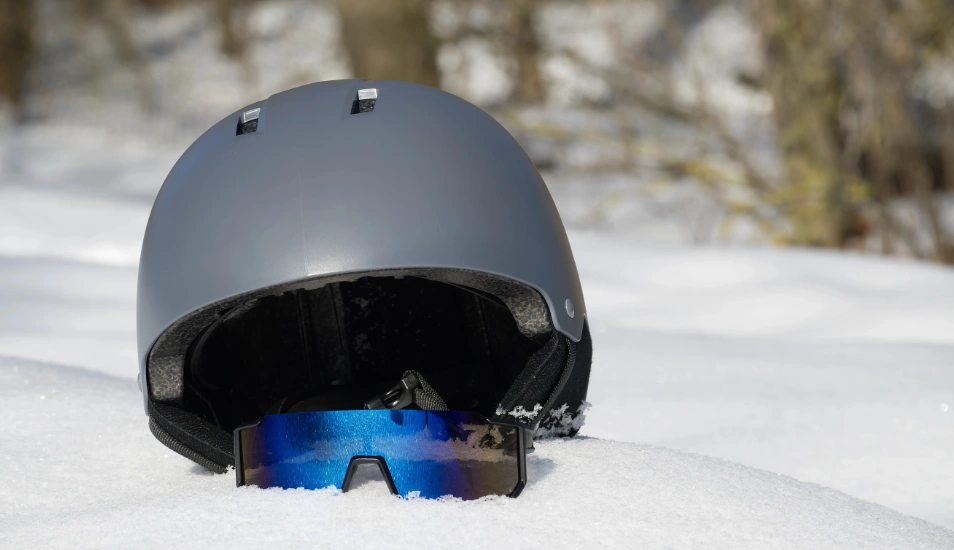
The material stops behaving the way you measured it
The reason this matters is that the energy management in a helmet is mostly the foam core, usually expanded polystyrene, sitting under a composite shell. The shell spreads the load, the foam absorbs it by crushing in a controlled way, and the whole design is tuned around how that foam responds.
Polystyrene does not respond the same way at -20 as it does at room temperature. Cold changes its stiffness, which changes how quickly it crushes, which changes the deceleration curve, which is the entire point of the object. D2H’s James Fewkes framed the core metric as peak deceleration, the idea being that a helmet works by stretching an impact out over milliseconds, and that shortening that window makes head injury outcomes worse very quickly rather than gradually.
So a foam that stiffens in the cold is a foam that decelerates the head faster. The helmet doesn’t fail. It just performs somewhere other than where you designed it, in exactly the conditions a winter sport helmet is guaranteed to see.
Ageing is the same problem on a longer timeline
Artificial ageing and water absorption are the version of this that runs over years instead of hours. Foam absorbs moisture. Materials cycle through heat and cold and UV. Adhesives and laminates change. None of it is dramatic on any given day and all of it moves the numbers.
Very little consumer product testing accounts for this, and helmets are one of the few categories where anyone even tries. You buy a chair, a ladder, a car seat, a bike rack, and the certification behind it almost certainly describes the object on day one. The version you’re using in year four has never been tested by anyone, including the people who made it.
That’s not a conspiracy, it’s a cost problem. Physically testing a product across a temperature range, and then again after accelerated ageing, and again wet, multiplies your test matrix by a large number. Every one of those cells is a physical sample, a fixture, and a slot on the lab calendar.
What actually changed here
This is where simulation earns its place, and it’s a more interesting claim than the usual one about speed. D2H ran more than thirty impact scenarios in a couple of days, varying environmental conditions, helmet positions, and anvil types.
The point isn’t that thirty runs is a lot. The point is that thirty physical drop tests across a temperature range with aged samples is a program, and thirty simulated ones is a Tuesday. When the marginal cost of asking “what about cold and wet and three years old” falls far enough, you start asking it. When it’s expensive, you test the version of the product that’s easiest to test, tell yourself the margin covers the rest, and ship.
Rand’s own people make a related point in a podcast episode on explicit dynamics solvers. GPU acceleration has pulled runs that used to take hours down to seconds, which is what makes exploring worst cases across variables like speed and temperature practical rather than aspirational. That speedup is hardware, not AI, and the distinction gets lost constantly. Their stated position on AI is narrower, useful for setup and automation and early predictions, not a substitute for someone deciding whether a result means anything.
The catch is that the model has to be right, and D2H was appropriately blunt about that. They correlated small-scale foam and composite simulations against physical material characterization testing before running any full helmet model, converting real test data into the stress-strain behavior the solver needed. Fewkes summarized the risk with the oldest line in the business, “rubbish in = rubbish out.”
That sequence is the whole thing. Physical testing didn’t get replaced, it got relocated. Instead of testing thirty finished helmets, they tested the materials carefully and then tested thirty helmets in software. The physical work moved earlier and got smaller, and the exploration moved later and got much bigger.
The transferable version
Ask what conditions your product is actually used in, then ask what conditions you tested in, and look at the gap.
For most things the gap is enormous and unexamined. Software gets tested on the developer’s machine with fast wifi and a warm cache. Signage gets designed on a monitor and installed in a hallway with different light. Furniture gets specified new and lives fifteen years. Interfaces get demoed by someone who built them and used by someone who arrived cold on a phone in bright sun.
None of those need a temperature chamber. They need someone to write down the difference between the test environment and the real one, and then decide on purpose which parts of that gap are acceptable. That’s a cheap exercise and almost nobody does it, because the tested version of a product is the version that works, and looking at the other one is uncomfortable.
The helmet people do it because the failure mode is a head injury. Everyone else gets to find out from customers.
Sources: Rand SIM, “D2H Advanced Technologies: Simulating Safety at Olympic Speed,” February 3, 2026. https://resources.randsim.com/case-studies/simulating-at-olympic-speed
EngTechnica, Future of Design & Engineering Software, with Jason Pfeiffer and Turner Jennings of Rand SIM. https://www.youtube.com/watch?v=lmC6yzd-Ouw
